The Test, Learn and Grow programme is working to design and improve public services so that everyone, whether you use, deliver, or design them, can see and feel the difference. We believe that a more iterative, person-centred and place-based approach is the best way to get us there and we want to make it easier to work this way.
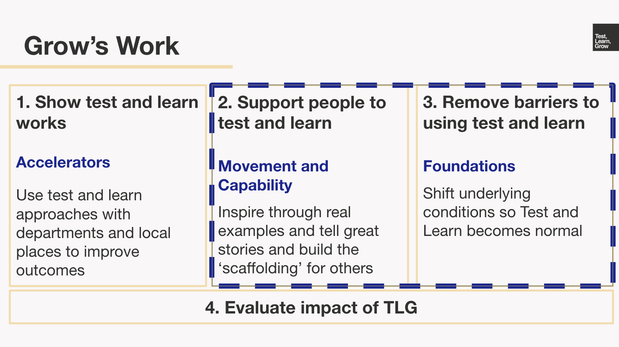
We’re trying to achieve three main things:
- Showing the difference test and learn makes
- Supporting people to use test and learn as a practice
- Removing barriers to using test and learn
You've already heard about our accelerators and how we test and learn on the ground, which is the main way we are doing the first part. The ‘Grow’ part of TLG focuses on the second two: building a movement, developing capability across all layers of government and strengthening the underlying foundations that make this way of working possible. While our accelerators show what works, ‘Grow’ wants to change the system to make it easier to test and learn wherever you are.
This matters beyond our own programme. The government's wider ambition to devolve power and funding depends on national, regional and local government being able to adopt new ways of working, including new technology, quickly and confidently. Grow is one part of making those ambitions real on the ground, working with partners across all tiers of government to rewire the state and build the skills, systems and confidence needed to adopt new ways of working.
Building a Movement
We believe that, in order to have a meaningful and long-term impact, we have to build a movement around test and learn as a practice. This is so that people know about it, get excited about it and learn how to do it in their local context. We do this by working in the open (like these blogs) and sharing what we learn as we go.
We are also constantly learning from people using innovative approaches to improve public services. We know many people are doing incredible test-and-learn-style work without necessarily using that name or being part of our programme, and we want to help share their work too.
Here’s a flavour of what this looks like in practice:
- Network & community building: TLG Network, Events, workshops & convenings and our LinkedIn Community (take a look and join!)
- Storytelling & communication: Working in the open, storytelling guidance, newsletters and external comms
- Engagement & relationship building: external collaborators and working with our TLG convenors
You can read more about this work soon.
Increasing capability
Once people know about test and learn, they need the skills, leadership and mindsets to pursue it, wherever it happens. We are working on this across central, regional and local government, alongside the wider public, private and third sectors, all of which have important and different roles to play.
So far we’ve pushed on this by launching the Regional Capability Fund, a £10 million fund to support up to 20 places, and partner with people across different central government departments that see things the same way that we do. We’re keen to keep sharing what we learn about what works well at different levels of public service delivery, and to keep learning from others too.
Shifting the foundations
We want to make it easy for people to test and learn, and remove barriers to doing it in situations where it works well. Through our accelerator projects and conversations with local partners and communities, we've found three main areas where strengthening the foundations would help:
- People and skills- building a culture of starting small, improving based on what we learn and working with the people closest to the problem;
- Systems, funding and processes- making it easier to use resources, increasing accountability and flexibility to meet the needs of those who use public services; and
- Technology and data- improving access to high quality information and resources that can be shared to support greater innovation and better outcomes.
So far, we have focused our efforts where we think we can have the biggest impact: tackling fragmented funding and showing how central and local government could work better together:
- Place-Based Budgets (run jointly with MHCLG)- pilots are underway in five regions and eighteen local authorities, giving places greater flexibility over how public service budgets in their area are spent. This helps reduce duplication and align funding and accountabilities so that services can join up around citizens and intervene earlier, supporting the government's wider ambitions for devolution and prevention-focused public services.
- Community Innovation Partnerships (run jointly with Places for Growth)- tests new ways of working across central and local government by partnering civil servants living and working in the regions and nations with their immediate local authorities to develop solutions to community challenges. We’ve delivered three of these and are exploring how best to expand the ways of working across the country.
We're also exploring other areas where we can support the new model of government, including how the updated Magenta Book's new guidance on test and learn approaches can help embed this way of working more widely. Let us know what you think the biggest challenges are and what we could do about them!
What does it all mean?
We are putting people and communities at the centre of how public services are designed and delivered, making it easier to learn from what we do and improve continuously. Alongside this, we're building a community around test and learn, helping develop the skills and capabilities needed to sustain it and removing barriers to adopting this way of working.
There’s a lot to do in a short period of time but I’m optimistic about what's possible and proud of the progress we’re making. I feel lucky to work with brilliant people across government, local authorities, communities, delivery organisations and more who bring so much knowledge, passion and creativity to the table.
To follow along with our work, subscribe for email notifications using the sign-up link, or join our Test, Learn and Grow community on LinkedIn. Comment or reach out to us with any ideas, questions, feelings, thoughts; we want to hear from you!
2 comments
Comment by john mortimer posted on
I would like to suggest an additional definition to your current definitions of Grow.
The Grow part of TLG is well described here, detaining what it really is. In particular, the way I read this is that Grow is about growing the movement and its influence. Thats fine, and that has occurred with other 'initiatives' in the public and private sectors. But I would like to highlight what has been learned from these that have occurred, as they succeed or often fallen back.
I am going to assume that we agree that TLG is a fundamental shift in the mindset as well as the concepts. It is not trivial or simply a different way of doing the same thing.
If we look at the perspective that TLG is to be developed, mature and become effective. The only way that something this deep is going to sustain is for it to be effective, not just have lots of knowledge and a large groundswell to it. Being effective is about making TLG work real and sustainable. Or else it will just remain a series of pilots with lots of documentation and interest around them. Which is where we are today with other initiatives.
The way to make something like this sustain is to make it stick. And the way to make it stick, is for the decision-makers to shift their understanding of the principles and concepts they hold dear to them.
So, another way of understanding how to make such a shift lies with pilots that grow in their local area of influence to become permanent. This is far more difficult that the TLG work currently being trialled, it is about the next stage. How to get the TLG work into real prototypes in organisations, that then begin the fundamental necessary shifts for permanent transformation. This has to be designed now, and cannot wait until we need it, as the progress in Grow as defined in this comment starts at the beginning of this work.
Comment by Author posted on
Thanks so much John for your insights, we completely agree that there needs to be more fundamental shifts in mindsets and conditions in the system that would enable this type of work to become the norm. The focus of the next iteration of the TLG playbook will be to unpack some of those conditions and how places are overcoming these challenges in practice. If you would like to chat with the team about this in further detail please drop us an email testlearnandgrow@cabinetoffice.gov.uk, as it would be great to get your thoughts.