Two years ago, I sat in a room with a small team to explore whether starting small, testing assumptions against real-world evidence, and bringing policy and delivery together in the same room could help build better public services, faster.
What if local government and communities worked with central government in a radically different way, putting partnership at the centre?
One year ago, we started putting those thoughts into practice with local authority partners across ten places. A lot has changed. The programme has become a community of change makers, a network of almost 2000 members, convenors from across the public sector lending their credibility and time, and a growing body of evidence about what actually happens when you try to change how government works from the inside out.
The recent publication of Rewiring the State set out a clear and ambitious context for exactly this kind of place-based reform. This means the Test, Learn and Grow (TLG) programme is no longer just making the case for a different way of working; the case has, in large part, already been made elsewhere, and more loudly than we could have made it ourselves.
What's exciting now is that we get to move into the hard yards: delivering the reform, and nurturing the mindsets, practices and organisational capabilities that make it stick.
What we set out to do, and what actually happened
At the time of starting the programme in 2024, we believed we could prove our initial question was true regardless of whether a technology or data solution was involved, and we wanted to show that the practices pioneered in digital service design could become a mainstream way of developing policy, not a niche one.
Mostly, that hypothesis has held up. But it's also been harder than any of us expected. There have been times where we found that an idea we were confident about simply didn't survive contact with the people it was meant to serve. None of that is failure in the way failure is usually talked about in government. We only know how an assumption plays out when we test it, not when we imagine it. Starting small means these setbacks are cheap, and they teach us something we couldn't have learned any other way. Failure is what happens when you commit large amounts of resource and attention without de-risking your approach through real world evidence.
What I've found most useful this year is a growing clarity about why TLG works. It isn't one method. It's really the combination of three different traditions. There's relational practice, anchored in communities, that works with the strengths and assets already present in the places we work alongside, rather than treating people as problems to be fixed. There's digital practice, with its internet-era instinct to start with the needs of the individual rather than the structure of the organisation. And there's policy, which sets the agenda and brings evidence in order to create the frameworks for legislation and investment that set the conditions for delivery. TLG doesn't ask teams to choose between these. It asks them to be curious about which combination fits the problem in front of them, with learning and adaptation as the thread that runs through all of them.
What we've learned as a movement
The thing I didn't fully anticipate a year ago was how much of this would end up being about people finding each other. Our humble LinkedIn network has rapidly grown to almost 2000 members, comprising council officials, civil servants, voluntary sector and wider public sector partners showing the thirst for people to be part of this work.
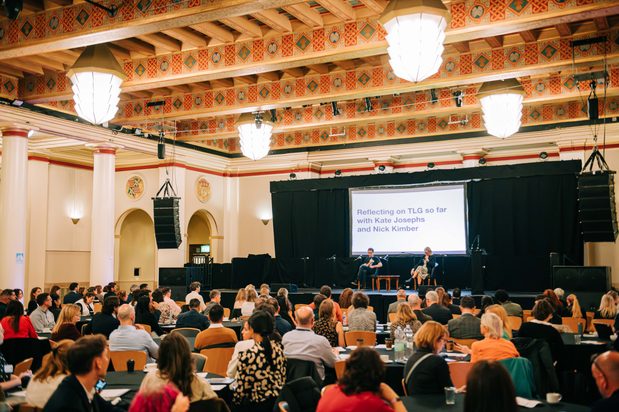
We've run an Unconference that brought together more than a hundred people who, in many cases, had been working in isolation on strikingly similar problems. The Department for Education has launched a sister team - a very first dedicated unit set up to take on the TLG approach, working alongside the Cabinet Office and sharing learnings. The test-and-learn network in the South West has formed and there’s genuine buzz and demand for this approach to public service reform, well beyond the ten TLG places themselves. We have welcomed four brilliant TLG convenors, Catherine Howe (Chief Executive, Dorset Council), Beth Russell (Second Permanent Secretary, HM Treasury), Paul Morrison (Director General, Home Office), and Emma De Closset (Chief Executive, UK Community Foundations) who publicly advocate for the network and sponsor initiatives.
This, alongside the Magenta Book annexe we published earlier this year, is part of building the infrastructure needed to support people working to solve complex problems by starting small, focusing on the needs of the individual, and closing the gap between policy and delivery.
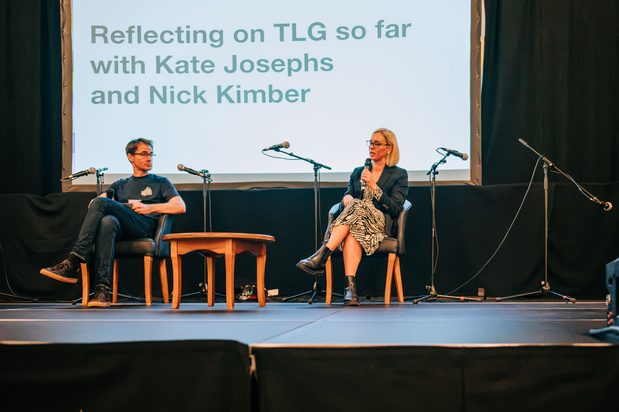
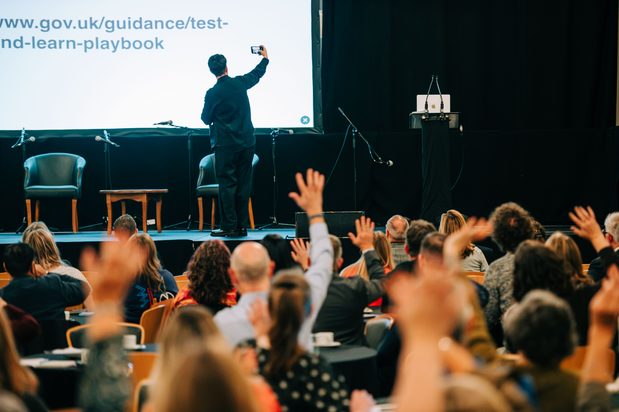
And we’ve captured all of this learning into a shared resource published yesterday: the Test, Learn and Grow playbook, a huge achievement and powerful resource to build on. On 20 October, we marked this with a dedicated celebration event in Sheffield alongside Kate Joseph, Chief Executive of Sheffield City Council and her team.
The harder truths
The work shows real promise but it’s also been really hard. There are things we would do differently and ways we could have gone faster or deeper and I want to be honest about what hasn't gone as smoothly. Data-sharing remains one of the most persistent blockers we face. Progress on some of our Grow work, removing the funding and governance barriers that sit underneath all of this, has been slower than I'd like, partly because changing how money and accountability flow is simply harder and slower than running a small test to show how we could improve a service.
There's a deeper truth underneath both of these. We think that for any approach to genuinely count as Test, Learn and Grow, it has to be deeply curious about the conditions needed to learn, adapt and improve, whether that's inside a local authority, an NHS trust, or a central government department. Many of those conditions are set by the centre, even where there's room to interpret the rules differently. That's why we call this work Grow: it's how we grow the conditions for organisations to solve problems alongside the people they serve, rather than in spite of the system around them. It's slower and less visible than the test-and-learn work in our accelerators, but essential to make the important shifts we need for this work to be easier than it is today.
Creating the right conditions means working bottom up, trusting the agility and creativity of people closest to those we serve, and top down, with leaders willing to hold space and risk for people with less power than themselves. We need both.
The Test, Learn & Grow Playbook
The publication of our Test, Learn and Grow playbook yesterday is an important milestone and reflects the progress we’ve made so far, as well as how far we have left to go.
The playbook turns a year of frontline experience into a practical and accessible guide, written by the people who have actually done this work, for others who want to do the same. It was built through real work and experiences in places, not written in advance of it. It will be updated more than once over the life of the programme, and we hope beyond it, as we learn more, and we expect that process to become more inclusive and democratic as the community around TLG grows.
It responds to a genuine demand from central and local government for resources to support the application of test and learn, from the practitioner who is ambitious for change and needs practical, honest support to make it happen, to the leader who has the power to make this way of working possible or stop it in its tracks. The approach we’ve taken has been to do the work, learn as we go, and share so others can respond. This playbook is one of the main ways we intend to do that.
It’s not prescriptive. We don't think any one organisation will have all the resources it needs to work this way all of the time, even if it wanted to, so the test for us isn't only what works, but what's useful to the widest possible number of people. At its best, we'd like to see a place or an organisation take what we've put together and build their own version of it, under their own steam, adding to a shared pool of knowledge rather than waiting for permission from the centre. This is an invitation to be part of this movement, not an announcement that the work is done.
Looking ahead
None of this is a victory lap. If anything, the better we get at this, the more clearly we can see how much further there is to go. In year two, our focus will be on removing and challenging the foundational barriers that make this work hard to implement and deepening our partnership with local government so that this work increasingly sits with places themselves rather than depending on a central team.
Rewiring the State may have changed the context we're working in but our job now is the harder one of delivering it, and building the mindsets and capabilities that make it last. The real test is whether this work helps services become integrated, preventative, relational and genuinely curious, continuously improving as they go, rather than treating that as a one-off project.
The clearest lesson from a year on from the launch of our accelerator projects is the power of combining traditions rather than choosing between them: relational practice that builds on local strengths, digital practice that starts from individual need, and policy practice that sets the strategic framework. Put together, with learning running through all three, they're more powerful than any one alone.
Leave a comment